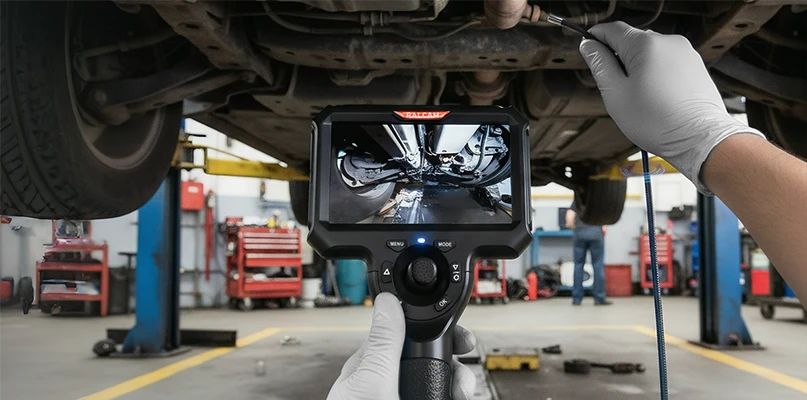
2-Way Articulating Borescope Series – Flexible and Accurate
Two-way steering handles most of the job. Ralcam 2-way articulating borescopes bend the camera tip up and down — up to 210° on the widest-bending models — enough to clear a bend, angle onto a cylinder wall, or turn into a branch line.


Original price
$199.00
Original price
$199.00
-
Original price
$199.00
Original price
$199.00
$99.99
-
$189.00
$99.99
-
$189.00
Current price
$99.99
Endoscope Camera for Android & iPhone – Ralcam F408A
Ralcam
In stock
Ralcam F408A — Phone-Connected Articulating Borescope with Built-In Battery The F408A turns your iPhone or Android into a professional inspection c...
View full details
Original price
$199.00
Original price
$199.00
-
Original price
$199.00
Original price
$199.00
$99.99
-
$189.00
$99.99
-
$189.00
Current price
$99.99
Save up to 50%


Original price
$138.99
-
Original price
$149.99
Original price
$138.99
-
$149.99
$138.99
-
$149.99
Current price
$138.99
Automotive Inspection Camera – Ralcam N505 | 2-Way Borescope
Ralcam
In stock
Ralcam N505 — Automotive Inspection Camera with 5" Screen The N505 pairs the largest screen in the 2-way range with a battery you can replace in th...
View full details
Original price
$138.99
-
Original price
$149.99
Original price
$138.99
-
$149.99
$138.99
-
$149.99
Current price
$138.99


Original price
$189.99
-
Original price
$209.99
Original price
$189.99
-
Original price
$209.99
Original price
$189.99
$129.99
-
$149.99
$129.99
-
$149.99
Current price
$129.99
Automotive Inspection Camera – Ralcam H406B | 4.3" Borescope
Ralcam
In stock
Something in there needs looking at, and you can't get your eyes to it — a rattle behind the dash, a drain that won't clear, a wall you'd rather no...
View full details
Original price
$189.99
-
Original price
$209.99
Original price
$189.99
-
Original price
$209.99
Original price
$189.99
$129.99
-
$149.99
$129.99
-
$149.99
Current price
$129.99
Save up to 29%


Original price
$199.99
Original price
$199.99
-
Original price
$199.99
Original price
$199.99
$119.99
-
$159.99
$119.99
-
$159.99
Current price
$119.99
Smartphone Borescope – Ralcam H406A | 6.2mm Engine Inspection
Ralcam
Out of stock
Ralcam H406A — Detachable Smartphone Borescope with Built-In Battery The H406A uses the same concept as the F408A — phone as your display, probe as...
View full details
Original price
$199.99
Original price
$199.99
-
Original price
$199.99
Original price
$199.99
$119.99
-
$159.99
$119.99
-
$159.99
Current price
$119.99
Sold out


Original price
$559.99
Original price
$559.99
-
Original price
$559.99
Original price
$559.99
Current price
$139.99
$139.99
-
$139.99
Current price
$139.99
Automotive Endoscope – Ralcam R406S | 4.3" HD Inspection
Ralcam
In stock
Ralcam R406S — Automotive Endoscope for Engine Inspection The R406S is built for one job: getting a clear look inside an assembled engine without p...
View full details
Original price
$559.99
Original price
$559.99
-
Original price
$559.99
Original price
$559.99
Current price
$139.99
$139.99
-
$139.99
Current price
$139.99
Save 75%


Original price
$165.99
Original price
$165.99
-
Original price
$165.99
Original price
$165.99
Current price
$119.00
$119.00
-
$119.00
Current price
$119.00
Portable Endoscope – Ralcam N306S | 3.5" Compact Inspection Camera
Ralcam
Out of stock
Ralcam N306S — Portable Endoscope with 3.5" Screen The smallest standalone scope in the Ralcam range. A 3.5" screen, a 6.2 mm probe and a quick-swa...
View full details
Original price
$165.99
Original price
$165.99
-
Original price
$165.99
Original price
$165.99
Current price
$119.00
$119.00
-
$119.00
Current price
$119.00
Sold out


Original price
$260.00
-
Original price
$329.99
Original price
$260.00
-
Original price
$329.99
Original price
$260.00
$168.00
-
$177.00
$168.00
-
$177.00
Current price
$168.00
Portable Articulating Borescope – Ralcam F408B
Ralcam
In stock
Ralcam F408B — Portable Articulating Borescope with 4.5" Screen The F408B is a stand-alone articulating borescope with a large 4.5" IPS display — b...
View full details
Original price
$260.00
-
Original price
$329.99
Original price
$260.00
-
Original price
$329.99
Original price
$260.00
$168.00
-
$177.00
$168.00
-
$177.00
Current price
$168.00
Save up to 49%

Original price
$139.99
Original price
$139.99
-
Original price
$139.99
Original price
$139.99
$109.99
-
$127.78
$109.99
-
$127.78
Current price
$109.99
Car Inspection Camera – Ralcam N308S | 8.5mm Engine Inspection
Ralcam
Out of stock
Ralcam N308S — Car Inspection Camera with 8.5 mm Probe At 1600×1200 the N308S resolves finer detail than most inspection cameras in its class — eno...
View full details
Original price
$139.99
Original price
$139.99
-
Original price
$139.99
Original price
$139.99
$109.99
-
$127.78
$109.99
-
$127.78
Current price
$109.99
Sold out


Original price
$69.99
-
Original price
$79.99
Original price
$69.99
-
$79.99
$69.99
-
$79.99
Current price
$69.99
USB Endoscope – Ralcam C106 | 6.2mm Flexible Engine Inspection
Ralcam
Out of stock
Ralcam C106 — USB Endoscope for iPhone, Android and Tablets No battery to charge, no app to pair. The C106 draws power over USB OTG from your phone...
View full details
Original price
$69.99
-
Original price
$79.99
Original price
$69.99
-
$79.99
$69.99
-
$79.99
Current price
$69.99
Sold out
When 2-Way Articulation Is Enough
Two-way is the most widely used borescope design for a reason. A single lever or wheel controls the tip, so you steer with one hand while you push with the other. To look sideways, you rotate the probe body — which, in a spark plug hole or a drain, is easy. For automotive engine checks, drain and pipe runs, and HVAC service, that is almost always the control you actually need, and it costs considerably less than a 4-way joystick platform.
2-Way Articulating Borescope Models
| Model | Display | Bend | Probe | Cable |
|---|---|---|---|---|
| F408B | 4.5" IPS | 210° | 8.5 mm | 1 m flexible |
| N505 | 5" IPS | 180°, probe lock | 5.5 or 6.2 mm | 1.5 m, up to 3 m |
| H406B | 4.3" IPS | 180° | 6.2 or 8.5 mm, detachable | Swappable probes |
| R406S | 4.3" | 30 mm steering radius | 6.2 mm | 1 m semi-rigid |
| N308S | Built-in | 90° | 6.2 or 8.5 mm | 1 m, 2 m, 3 m semi-rigid |
| N306S | 3.5" IPS | 2-way, probe lock | 6.2 mm | 1 m rigid |
| F408A | iPhone or Android | 180° | 5.5 or 8.5 mm | 1.5 m flexible or 1 m rigid |
| H406A | iPhone or Android | 180° | 6.2 or 8.5 mm, detachable | 1–3 m or custom |
| C106 | iPhone or Android | 30 mm steering radius | 6.2 or 8.5 mm | 1 m flexible |
Bend angle: what the number means
The bend angle is how far the tip can turn from straight. A bigger angle lets you look further back along a surface — useful for the top of a cylinder or the far side of a pipe fitting. A tighter steering radius matters more in narrow bores, where the tip has little room to swing. For most engine and drain work, anything from 90° up does the job; reach for 180°–210° when you need to look back at what you just passed.
Sizing
Camera diameters run 5.5 mm, 6.2 mm, and 8.5 mm across this series, on cables from 1 m to 3 m in flexible, semi-rigid, and rigid form. Semi-rigid is the default recommendation for engines: it holds the curve you set, which keeps the tip pointed at the cylinder wall instead of sagging into the bore. Flexible cable follows ducts and wall voids; rigid tube goes straight where you aim it. See the probe diameter guide for sizing by job.
Screen or phone
Models here come both ways — built-in screens from 3.5" to 5" for standalone work, or phone-connected probes that turn an iPhone or Android into the display, connected by cable.
Using an Articulating Borescope Camera With Light
Every 2-way model has adjustable LEDs at the tip. Turn them down on shiny or wet surfaces — a cylinder wall or a wet pipe reflects light straight back and washes out the image. Turn them up in dark, matte spaces like wall cavities and duct runs. The 8.5 mm heads carry more LEDs and light a larger space.
When to step up
If you need to look back along a surface, sweep a combustion chamber methodically, or navigate a compound bend, the tip has to move left and right too — that is 4-way articulation. For engine-specific guidance, see automotive borescopes.
All probes are IP67 rated with adjustable LED illumination for oily, wet, and dusty work.