

Borescope vs Endoscope vs Inspection Camera: What's the Difference?
Search for an inspection tool and you will get the same product sold under three different names. One listing calls it a borescope. The next calls it an endoscope. A third calls it an inspection camera. Buyers reasonably assume these are three categories of tool with three different capabilities — and then spend an hour trying to work out which one they need.
Here is the short version of borescope vs endoscope: for the products you will actually find on a shopping site, the three terms mostly describe the same thing. The differences are historical and contextual, not technical. This guide explains where each word came from, where they genuinely diverge, and what you should be comparing instead of names.
The Short Answer
| Term | Where it comes from | What it usually means today |
|---|---|---|
| Borescope | Industrial — literally a scope for looking down a bore | The standard technical term for an industrial inspection scope |
| Endoscope | Medical — from Greek roots meaning "to look inside" | Medical instruments, but widely borrowed for industrial tools too |
| Inspection camera | Consumer marketing — a plain-English description | A digital scope aimed at DIY and general trade buyers |
If a listing calls a probe-on-a-cable an "endoscope" and another calls the near-identical product a "borescope," that is a naming choice, not a spec difference. Compare the specifications, not the label.
Borescope vs Endoscope: Side-by-Side
The naming overlaps, but an industrial borescope and a medical endoscope are built for very different jobs. This is where the two genuinely diverge:
| Industrial borescope | Medical endoscope | |
|---|---|---|
| Used on | Engines, pipes, walls, turbines, welds, machinery | The human body |
| Built for | Oil, fuel, coolant, dust, and repeated abrasion | Sterilization and patient safety |
| Regulation | General electrical and product standards | Regulated as a medical device |
| Probe | Rigid, semi-rigid, or flexible; often armored cable | Flexible, biocompatible insertion tube |
| Typical buyer | Mechanics, plumbers, inspectors, engineers, DIYers | Hospitals and clinics |
| Price bracket | Tens to a few thousand dollars | Many thousands of dollars and up |
So when a shopping site calls an engine camera an "automotive endoscope," it is using the word loosely. The product is an industrial borescope.
What "Endoscope" Actually Means
Endoscope is the oldest and broadest of the three. It comes from Greek roots meaning roughly "to look inside," and its primary home is medicine: the instruments used to examine the digestive tract, joints, airways, and other internal structures.
Medical endoscopes are a genuinely different class of hardware from anything on this site. They are built to standards for sterilization and patient safety, are designed to be used inside a living body, and are regulated accordingly. An industrial scope is not a medical device and must never be used as one.
That said, the word escaped the hospital a long time ago. Because "endoscope" simply means an instrument for looking inside something, manufacturers and sellers of industrial tools use it freely — which is why you will see "automotive endoscope" and "industrial endoscope" on products that a technical spec sheet would call borescopes. If you want the fuller background, we cover it in what is an endoscope.
What "Borescope" Actually Means
Borescope is the precise industrial term. The name is literal: a scope for inspecting a bore — the inside of a cylinder, a barrel, a pipe, a drilled hole. It emerged from engineering and manufacturing contexts, where the job was checking machined surfaces and internal bores without taking the assembly apart.
This is the word to use if you want to be understood by engineers, machinists, aviation technicians, and NDT (non-destructive testing) professionals. In technical documentation and procurement, "borescope" is the standard term, and "borescope inspection" is the standard name for the procedure.
Within the borescope category there are real, meaningful subdivisions — rigid, flexible fiberscope, and digital video designs, each suited to different access and image requirements. Those distinctions matter far more than the borescope-versus-endoscope naming question, and we break them down in types of borescopes explained.
What "Inspection Camera" Means
Inspection camera is the newest of the three and the least technical. It is a plain-English marketing term, and it almost always refers to a digital tool: a camera sensor on a flexible probe sending an image to a screen or a phone.
The term became popular as these tools got cheap enough for general consumers, because "inspection camera" is self-explanatory in a way "borescope" is not. Someone looking for a wall leak does not necessarily know the word borescope; they know they want a camera to inspect something.
Because it is a consumer-facing term, products marketed this way skew toward the affordable end — but that is a tendency in the market, not a rule about the technology. Plenty of capable professional tools are also sold as inspection cameras.
Boroscope, Bore Scope, Videoscope: Other Names You Will See
A few more spellings and labels cause the same confusion:
- Boroscope and bore scope are common misspellings of borescope. They mean exactly the same thing.
- Videoscope or video borescope is a borescope with a camera sensor at the tip, rather than glass optics or fiber bundles. Almost every digital inspection tool sold today is a videoscope in this sense.
- Fiberscope is an older flexible design that carries the image back through a bundle of optical fibers. It has largely been replaced by tip-camera videoscopes.
- Snake camera is the trade and DIY nickname for a flexible inspection camera, especially for drains and walls.
- Articulating borescope describes a scope whose tip can be steered from the handle — 2-way (up and down) or 4-way (all directions). That is a real capability difference, unlike the naming above. See articulating vs non-articulating borescopes.
Why the Terms Overlap So Much
The blurring is not an accident. Sellers use whichever word buyers are searching for, and buyers search for whichever word they happened to encounter first. A manufacturer who calls the product only a "borescope" is invisible to everyone searching "endoscope for car engine," so most sellers hedge and use several terms across their listings.
The practical consequence: you cannot infer anything about a product's quality, class, or capability from which of the three names it is sold under. A well-built professional tool and a poor one can carry identical labels.
Does the Distinction Matter When You're Buying?
Only in two situations:
- Medical use. If you actually need a medical endoscope, none of the industrial products discussed here are appropriate, regardless of what they are called. That is a regulated category with entirely different requirements.
- Professional and procurement contexts. If you are writing a spec, filing an inspection report, or talking to engineers, use "borescope." It is the precise term and signals that you know the field.
For everything else — buying a tool to look inside an engine, a wall, a pipe, or a gearbox — the name on the box tells you nothing useful. What actually determines whether the tool works for your job:
- Probe diameter — whether it physically fits your access opening
- Working length — whether it reaches your target
- Image quality and lighting — whether you can actually see the defect
- Articulation — whether you can aim the tip once inside
- Sealing and cable durability — whether it survives your environment
Those five specs decide the purchase. Our guide to how to choose a borescope walks through each in order.
Which Term Should You Search For?
Practical advice: search all three. Because sellers label inconsistently, restricting yourself to one term hides a large part of the market from you. "Borescope" surfaces the more technical and industrial listings, "endoscope" catches automotive-focused products, and "inspection camera" pulls in the consumer and general-trade end. Run all three and compare on specs.
Borescope vs Endoscope: Frequently Asked Questions
Is an endoscope the same as a borescope?
For industrial tools, yes — sellers use the two words interchangeably for the same product. The only real split is between industrial scopes and medical endoscopes, which are regulated medical devices and a different class of hardware.
Can I use a borescope as a medical endoscope?
No. Industrial borescopes are not designed, sterilized, or approved for use on people or for medical diagnosis, whatever they are called in a listing.
What is the borescope term meaning in plain English?
A borescope is a camera or optical scope on the end of a probe, used to look inside something through a small opening — originally the bore of a cylinder or barrel, now anything from an engine to a wall cavity.
Is an inspection camera a borescope?
In practice, yes. "Inspection camera" is the consumer-friendly name for a digital borescope. Judge it by probe diameter, cable length, image quality, lighting, and articulation — not by the label.
Which one do mechanics use?
Mechanics use industrial borescopes, whether the box says borescope, endoscope, or inspection camera. For engine work, a 5.5–6.2 mm probe that fits a spark plug hole and a semi-rigid cable that holds its shape are what matter. See automotive borescope cameras.
Where to Go From Here
Now that the terminology is out of the way, the useful next step is understanding the actual design categories — rigid, flexible, and video borescopes — and then sizing one to your job with our borescope buying guide. For a deeper look at professional applications, see our guide to the industrial borescope inspection camera.
Ralcam manufactures digital video borescopes directly from our factory in Shenzhen — you will see them listed under all three names, because that is how buyers search. Browse the industrial borescope cameras range for maintenance, welds, and plant work, or the automotive borescope cameras range for engine and cylinder inspection. Not sure which specs your job needs? Tell us what you are inspecting and we will give you a straight answer.
Looking for the right borescope?
Browse the full Ralcam range — industrial and automotive inspection cameras for every job.
Shop all borescopes →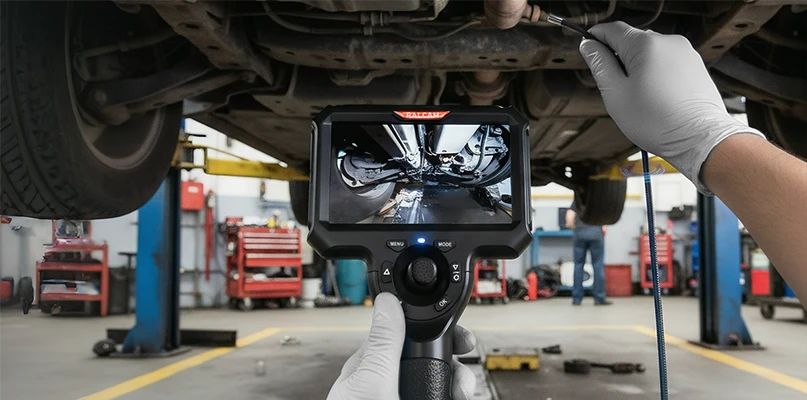
Leave a comment